
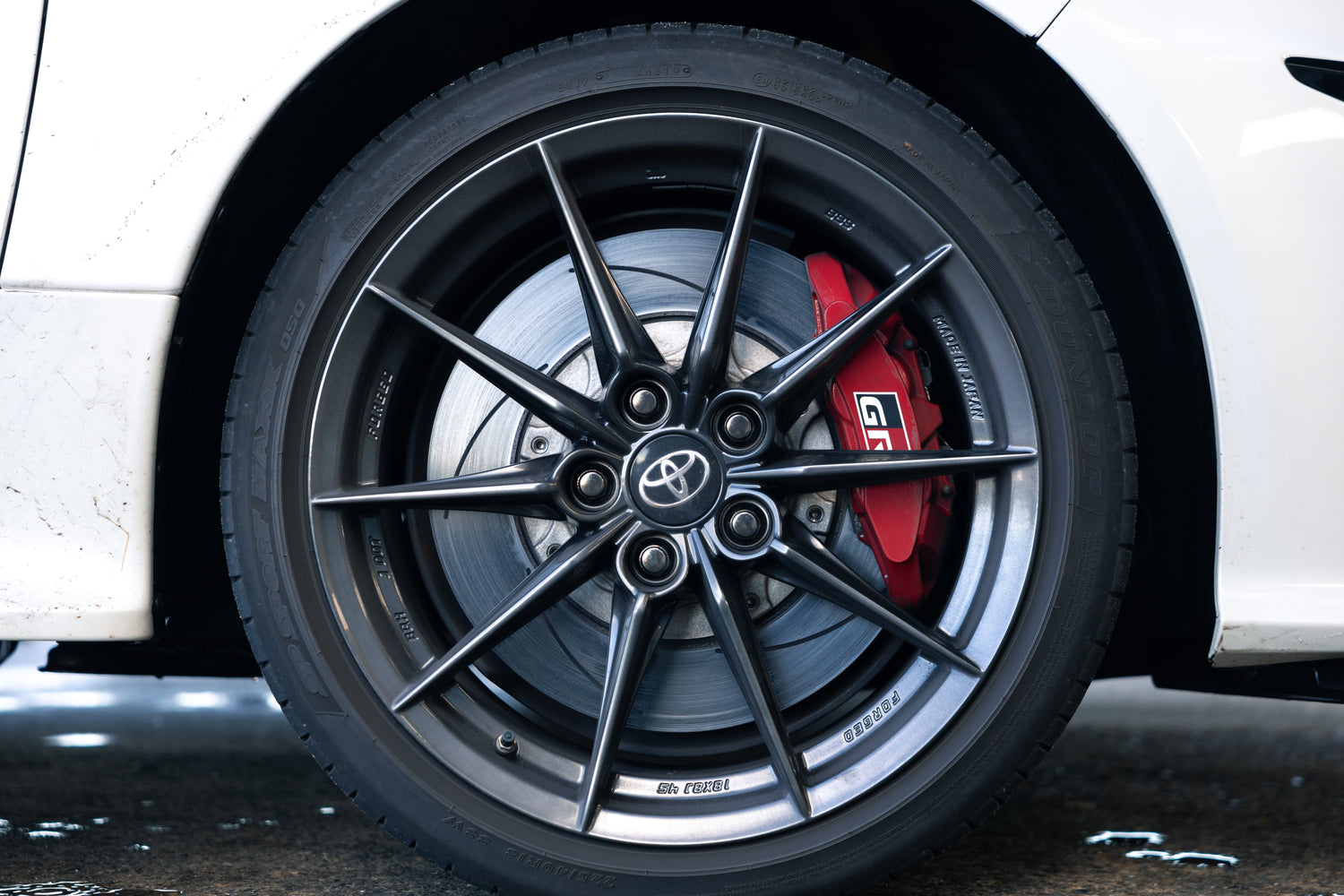
Go to any track day and you'll find drivers who've spent serious money on tyres, suspension, and power and weight-saving upgrades - but have neglected the braking system. This tends to reveal itself from lap three, when the pedal goes soft and the car simply doesn't slow down the way it should.

Brakes on a circuit face a completely different challenge to road use. You're braking hard at the end of every straight, lap after lap, with almost no recovery time. Heat builds relentlessly. And if the system can't manage it, you get brake fade - that terrifying combination of a soft, distant pedal and an alarming increase in stopping distance. The two main causes of fade are a) heat causing a drop in friction between the pad and disc – thought to be caused by thermal damage to the brake pad (though these days, track-specific brake pads are virtually immune to this), and, b) heat getting into the brake fluid.
Tribol’s Full-Composite Brake Pads are highly insulating compared to conventional steel, offering an effective thermal barrier, and completely changing the thermal dynamics of the braking system with serious advantages.

Where You Want the Heat - and Where You Don't
Every time you brake, kinetic energy becomes thermal energy at the pad-to-disc interface. That energy has to go somewhere, and where it goes determines whether your braking system works or fails.
The brake disc is your ally here. A ventilated disc has a large surface area, spins through the air, and is specifically designed to radiate and convect heat away from the car. The hotter the disc, the steeper the temperature gradient between the disc surface and the surrounding air - and physics tells us that a steeper gradient means faster heat transfer. A hotter disc, in other words, actually sheds heat more efficiently.
This is where the composite backing plate's low thermal diffusivity becomes critical. Because it resists the rearward flow of heat so effectively, more thermal energy stays in the disc rather than migrating through the pad and into the caliper. Disc temperatures run higher as a result - which, counterintuitively, is exactly what you want.
"But doesn't a hotter disc mean more brake fade?" It can - but only if you're running the wrong pad compound. A proper race-spec friction compound is formulated to operate at high temperatures without losing its grip. Fade resistance at elevated temperatures is precisely what distinguishes a genuine track pad from a road pad. With the right compound in place, there's no penalty to keeping disc temperatures high. There's only the benefit: a disc that's radiating heat into the air more aggressively and recovering more quickly between braking events.
In a braking system, temperatures are never stable - they spike hard during a braking event and begin recovering the moment you release the pedal. It's a system in constant thermal flux, not settling into the kind of steady, consistent heat flow. Thermal diffusivity is the more useful comparative measure here because it captures how quickly a pulse of heat actually travels through a material - factoring in not just how well the material conducts heat, but how much heat it can absorb and hold along the way. In a transient system full of sudden temperature spikes, that distinction is everything.
A phenolic-carbon composite backing plate, at around 1.15W/(m.K), has a thermal conductivity nearly 60 times lower than mild steel at 65W/(m.K). What this means in practice is that when heat is generated at the pad-to-disc interface, the composite material slows that thermal pulse dramatically as it tries to travel rearward through the pad. The heat doesn't disappear - but it is delayed, and that delay is the whole game.
By holding the heat back from the caliper, it is forced to stay where you want it: in the disc. The disc is spinning through air at speed, shedding heat from its surface continuously. Every extra millisecond that heat spends in the disc rather than conducting rearward through the pad is another millisecond the disc has to radiate that energy away. The composite backing plate isn't just protecting the caliper — it's actively buying time for the disc to do its job. The result is a braking system that dissipates heat more efficiently at the point it was always designed to, while keeping the components behind the pad cooler and safer in the process.
Independent dynamometer testing confirms the science, with back to back testing showing discs running 50-75oC hotter on composite backed pads than their steel counterparts, but with the caliper running cooler as a consequence.
Further confirmation has been seen in track testing, with professional test drivers using composite pads reporting all the expected benefits: pads which delivered solid, consistent braking, without degradation in performance throughout an extensive day of testing. This was in spite of the discs seeing temperatures north of 650oC, whilst the calipers did not exceed 140oC.
Why is it important to keep heat on the disc?
When heat migrates rearward through the pad instead of staying in the disc, it enters components that are considerably less well designed to handle it.

The caliper body absorbs heat into its pistons and seals. Caliper seals are rubber, and rubber has a finite temperature tolerance. Sustained high temperatures cause them to harden, crack, and eventually fail - leading to fluid leaks, sticking pistons, and uneven pad wear. On top of this, aluminium calipers often having requirements stipulating professional inspection should the body temperature exceed 210oC.
More critically, heat that reaches the brake fluid is an immediate and genuine safety issue. Brake fluid boils when it gets too hot - particularly when poorly maintained, creating gas bubbles in the hydraulic lines. Unlike liquid, gas is compressible - so those bubbles turn a firm, predictable pedal into something that feels like pushing a sponge, with dramatically increased stopping distances to match. In extreme cases, hydraulic pressure drops to the point where the brakes barely function at all. A composite backing plate, with its 60-fold advantage in thermal conductivity over steel, keeps this heat at bay far more effectively, giving you more consistent pedal feel and a meaningful safety margin across a full session of hard braking.
A steel-backed pad offers no such barrier. Heat has a direct, low-resistance path from the friction surface, through the steel plate, and straight into the caliper. You can compensate with titanium shims and aggressive brake ducting - and many people do - but that's treating the symptom rather than the cause. The composite backing addresses it at source.
Keeping It All in Perspective
The logic, then, is elegant: a composite backing plate keeps heat in the disc, where it belongs. The disc runs hotter, sheds heat into the air more efficiently, and the braking system as a whole is more thermally effective. Meanwhile, the caliper and brake fluid stay cooler, seals last longer, pedal feel stays consistent, and the risk of vapour lock drops significantly.
It's one of those upgrades where the physics works entirely in your favour - you're simultaneously making the heat dissipation side of the system more efficient and protecting the components that suffer when heat reaches them.
Oh, and there's one final benefit that rarely makes it into the technical literature: lower caliper temperatures mean your pristine red calipers are considerably less likely to slowly bake themselves into an embarrassing shade of orange-brown. Performance and aesthetics, for once, pulling in exactly the same direction...
About the Author
Dr Luke Savage
CTO & Co-founder, Tribol Braking
Dr Luke Savage is the CTO and Co-founder of Tribol Braking, bringing deep technical expertise in braking systems, friction materials, and high-temperature performance.
Luke’s career began with a PhD focused on “High Temperature Properties of Automotive Friction Materials”, and has since included managing over 20 successful Innovate UK-funded projects spanning materials science, braking technology, and automotive engineering.
The research underpinning Tribol Braking originated from one of these programmes, providing the foundation for the company’s composite brake technology. Luke continues to lead Tribol’s technical direction, ensuring every product is grounded in validated science, rigorous testing, and real-world performance.


Leave a comment
All comments are moderated before being published.
This site is protected by hCaptcha and the hCaptcha Privacy Policy and Terms of Service apply.