


The automotive industry is undergoing its most radical architectural shift in a century, driven by the dual forces of electrification and Software-Defined Vehicle (SDV) engineering. At the heart of this transformation is the transition from traditional hydraulic systems to "by-wire" technologies. While Drive-by-Wire (electronic throttles) and Steer-by-Wire have steadily matured, Electro-Mechanical Braking (EMB) represents the final frontier in complete chassis electrification. Often referred to as "dry" Brake-by-Wire, EMB completely replaces the hydraulic master cylinders, vacuum boosters, brake fluid and fluid lines with decentralized electric actuators mounted directly to the wheel calipers. As vehicles demand faster reaction times for Advanced Driver Assistance Systems (ADAS) and tighter integration with regenerative braking systems, global interest in EMB has surged, with a market projected to reach USD 15.0 billion by 2035. The journey toward mass-market Electro-Mechanical Braking is accelerating, with China acting as the primary volume driver and Western engineering giants such as Bosch and ZF braking Systems standardizing the hardware.
It’s All About Actuation Speed
In a traditional hydraulic braking system, the response timeline typically spans 300 ms to 500 ms. When a brake command is initiated, conversely, an EMB system achieves an ultra-fast response speed of under 100 ms - and can be as short as 75 ms.

The Linchpin of Autonomous Vehicle (AV) Technology
As autonomous vehicle technology progresses from basic driver assistance toward Level 4 (High Automation) and Level 5 (Full Automation), the speed and architectural design of the braking system dictate the viability of the entire self-driving stack. But this reduction in stopping distance and simplification of the braking architecture has not come without problems.
The Thermal Problem: Magnets and Extreme Heat
Because EMB eliminates hydraulic fluid, it removes a critical medium that historically absorbed and carried away localized friction-generated heat energy. Under heavy or prolonged braking temperatures regularly exceeds 600°C to 800°C. The EMB motor sits inches away from this intense thermal source.
When electric motor magnets are exposed to these extreme temperatures, they run the risk of reaching their Curie point or experiencing irreversible thermal demagnetization. As the magnetic flux density degrades due to heat, the motor loses torque capacity, i.e. the actuator cannot deliver the clamping force required to stop the vehicle, leading to catastrophic brake fade or complete actuator failure. Furthermore, intense heat breaks down the insulation coating on the magnet wire coils, triggering short-circuits and electrical leakage.

What is the Cure?
One option is to raise the curie point on magnets - and whilst development of new higher coercivity materials is ongoing, progress is slow and solutions expensive. A more immediate method is to build in liquid cooling into calipers, a huge engineering upheaval adding weight, cost and complexity – ironically undoing one of the major advantages of doing away with hydraulic actuation. The current popular approach is to install aerogel insulators, reflective heat shields, or specialized ceramic barriers between the friction caliper and the motor housing, but these solutions require a caliper and corner assembly redesign, where adding effective physical shielding layers requires more space in the hub. Aerogel and ceramics are also brittle, especially when deployed as a thin shim as subject to bending failure, and struggle to cope with typical 60-180bar caliper pressures.
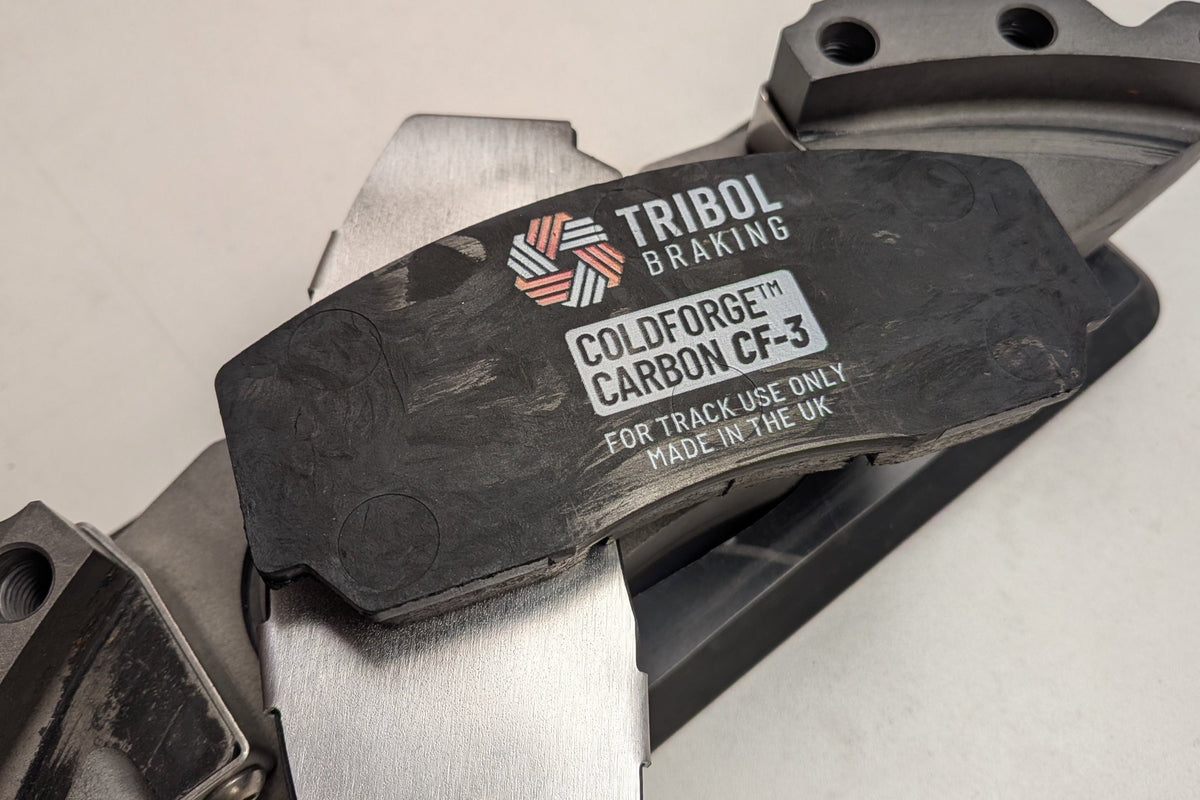
Tribol’s Full Composite Brake Pads are the new entrant into this arena as an obvious and immediate solution, offering a material with 60x lower thermal conductivity than steel-backed brake pads, and around half that of Zirconia ceramic (1.13 W/(m·K) vs 1.7-2.7 W/(m·K)). More importantly, because the entire 4-6mm thickness of the Tribol pads are made from insulating composite, the thermal barrier provided is enormous compared to a thin (1mm) zirconia ceramic shim. Also, Tribol pads are engineered to directly replace the conventional steel-backed pad, so no costly reengineering or additions to the braking system are needed, and no allowances for more space in the wheel hub are required.
About the Author
Dr Luke Savage
CTO & Co-founder, Tribol Braking
Dr Luke Savage is the CTO and Co-founder of Tribol Braking, bringing deep technical expertise in braking systems, friction materials, and high-temperature performance.
Luke’s career began with a PhD focused on “High Temperature Properties of Automotive Friction Materials”, and has since included managing over 20 successful Innovate UK-funded projects spanning materials science, braking technology, and automotive engineering.
The research underpinning Tribol Braking originated from one of these programmes, providing the foundation for the company’s composite brake technology. Luke continues to lead Tribol’s technical direction, ensuring every product is grounded in validated science, rigorous testing, and real-world performance.

Leave a comment
All comments are moderated before being published.
This site is protected by hCaptcha and the hCaptcha Privacy Policy and Terms of Service apply.