
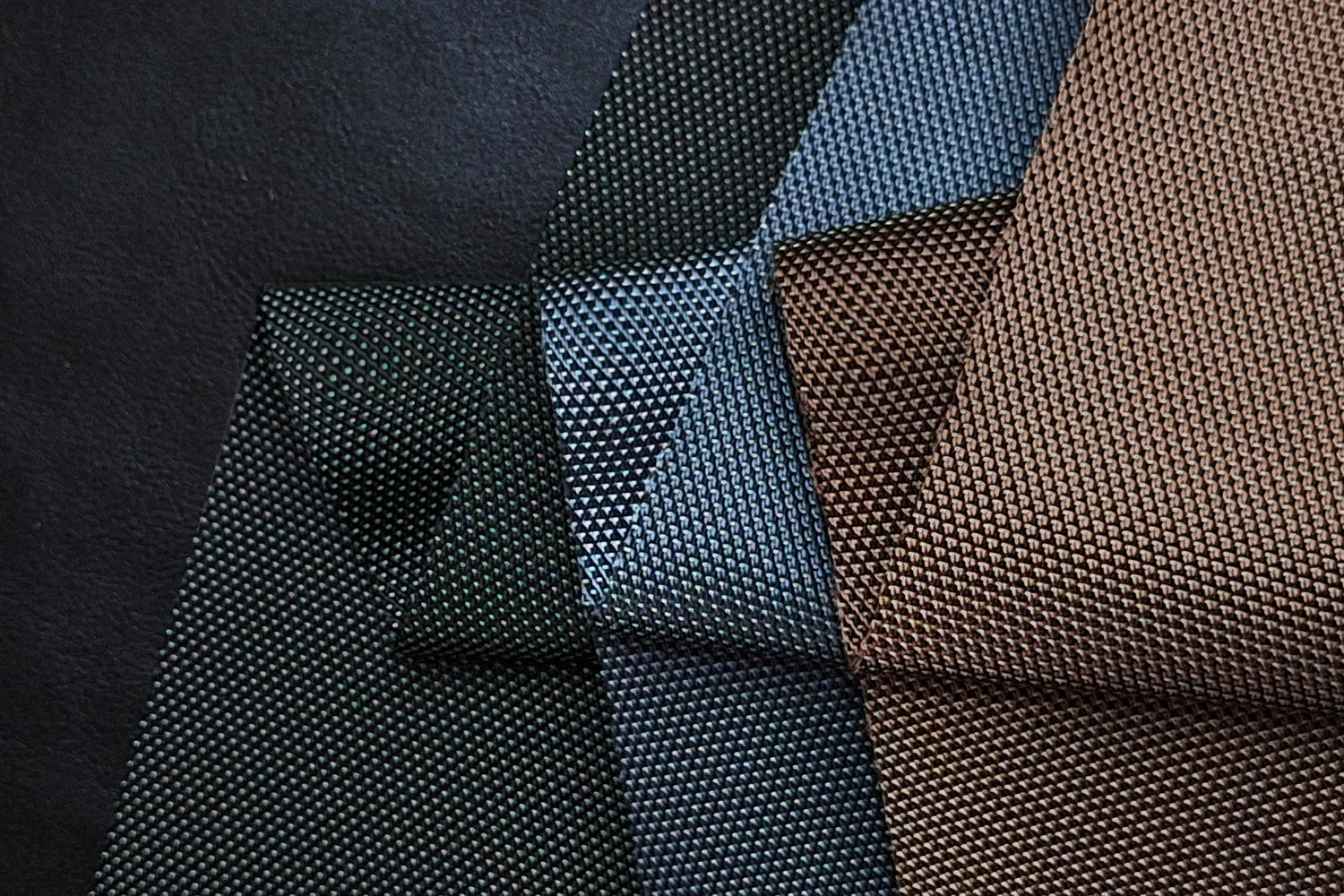
How Tribol Brake Pad materials were selected
Our goal was to select materials capable of handling the extreme heat and forces generated during high‑performance braking, while delivering performance beyond what traditional brake pads can offer.
A key part of this development was identifying fibres, resins, and manufacturing processes that remain stable through the intense temperature changes, pressure loads, and mechanical stresses that occur every time the brakes are pushed to their limits.
A key part of this development was identifying fibres, resins, and manufacturing processes that remain stable through the intense temperature changes, pressure loads, and mechanical stresses that occur every time the brakes are pushed to their limits.
Materials Chosen for Extreme Performance
Among the various fibres available for composites, glass and carbon fibres stood out as capable of meeting the demands of high energy braking.
Together, these fibres can create a hybrid system that balances rigidity with resilience that are essential for a backing plate to remain dimensionally stable with maintained characteristics under intense mechanical and thermal stress.
To bind the fibres and carry load between them, we needed a resin system that would not soften, melt, or degrade when exposed to the temperatures generated during aggressive braking. After evaluating available options, we selected phenolic resin, the same material family NASA uses in ablative heat‑shield composites.
Together, these fibres can create a hybrid system that balances rigidity with resilience that are essential for a backing plate to remain dimensionally stable with maintained characteristics under intense mechanical and thermal stress.
To bind the fibres and carry load between them, we needed a resin system that would not soften, melt, or degrade when exposed to the temperatures generated during aggressive braking. After evaluating available options, we selected phenolic resin, the same material family NASA uses in ablative heat‑shield composites.
Glass Fibre
- Provides excellent impact absorption and thermal shock resistance
- Naturally corrosion resistant and stable in harsh environments
- Offers strong insulation properties, reducing heat transfer into the brake caliper
Carbon Fibre
- Extremely high stiffness to weight ratio for engineered load control
- Maintains structural integrity under rapid temperature changes
- Lightweight reinforcement that resists bending under peak braking forces
Phenolic Resin
- Withstands high heat and forms a protective char layer under extreme heat, enhancing its thermal‑shielding performance
- Adhesion maintained at elevated temperatures and efficiently transfers load across the fibres, increasing overall strength of the brake pad
- Chemical Resistance protects the backing plate from oils, brake fluids, and corrosion
Engineered Fibre Structure
The structural performance of our composite backing plate depends not only on the materials used, but on their arrangement within the laminate. Tribol’s backing plates use a deliberately engineered fibre architecture designed to carry braking loads efficiently in every direction, resist distortion at high temperature, and maintain stiffness under extreme braking forces.
- Multi directional load bearing ensures the backing plate maintains its geometry even when subjected to uneven pad wear, asymmetric piston forces, or high frequency vibration
- Improved interlaminar strength reduces the risk of delamination, a common failure mode in composites exposed to repeated thermal shock and mechanical loading
- Enhanced thermal stability comes from distributing fibres in orientations that counteract expansion, preventing warping or tapering when the disc reaches extreme temperatures
Why Glass Transition Temperature Matters for Brake Backing Plates
For composite brake backing plates, the glass transition temperature (Tg) is one of the most critical performance limits. Tg defines the point where the resin matrix shifts from a stiff, glass like solid to a softer, rubber like state. Below Tg, the resin locks the fibres in place and transfers load efficiently. Above Tg, stiffness drops rapidly and a backing plate that loses stiffness cannot maintain pad geometry or pedal feel.
Tribol’s material system is engineered so that its effective Tg sits far above the temperatures reached during aggressive braking, ensuring the composite stays rigid even when the disc is glowing. This high Tg is what allows the backing plate to resist bending, tapering, and mechanical creep under sustained braking forces. Ultimately, a high glass transition temperature is not merely a material characteristic, it is a fundamental requirement for maintaining consistent braking performance.
Tribol’s material system is engineered so that its effective Tg sits far above the temperatures reached during aggressive braking, ensuring the composite stays rigid even when the disc is glowing. This high Tg is what allows the backing plate to resist bending, tapering, and mechanical creep under sustained braking forces. Ultimately, a high glass transition temperature is not merely a material characteristic, it is a fundamental requirement for maintaining consistent braking performance.
Post Cure: Unlocking Full Thermal and Mechanical Capability
After the composite is moulded, it undergoes a controlled post cure cycle. This step is essential for maximising the performance of any thermosetting resin system.
During post cure, the resin continues to crosslink, forming a denser and more thermally stable polymer network. This process delivers several key advantages:
During post cure, the resin continues to crosslink, forming a denser and more thermally stable polymer network. This process delivers several key advantages:
- Higher stiffness and improved load transfer as the resin becomes more rigid and better bonded to the fibres, helping maintain consistent pedal response
- Elevated effective Tg, allowing the composite to remain structurally stable at temperatures that would soften conventional resin systems (e.g. epoxy)
- Greater resistance to creep and deformation, ensuring the backing plate maintains its shape under sustained braking pressure
Holes in brake pads can raise the operational glass transition temperature
The introduction of holes in brake pads does not chemically increase Tg but pragmatically raises the effective Tg by controlling heat flux, local free volume, and dynamic relaxation, allowing the pad to withstand higher operating temperatures without softening.
Key points are:
- Enhancing heat dissipation, lowering thermal spikes at critical contact points
- Creating non-uniform stress and thermal distributions, which reduce local molecular mobility
- Inducing dynamic effects where rapid heating prevents instantaneous softening, giving the material a higher apparent transition temperature
Conclusion
The result is a composite backing plate that behaves consistently across repeated heat cycles, maintains its geometry under extreme loads, and delivers the stable braking feel drivers expect, even in the harshest conditions.
[1] Violette, S. (2019). Sustaining Phenolic Impregnated Carbon Ablator (PICA) for Future
NASA Missions Including Discovery and New Frontiers. https://ntrs.nasa.gov/api/citations/20190028929/downloads/20190028929.pdf
[2] Gombos, ZJ, McCutchion, P, Savage, L. Thermo-mechanical behaviour of composite moulding compounds at elevated temperatures, Composites Part B: Engineering, 2019, https://doi.org/10.1016/j.compositesb.2019.106921
[3] Kim, S. S., & Kim, H. J. Thermal Behavior and Cure Characteristics of Phenolic Resin Systems, Journal of Applied Polymer Science, Vol. 88, 2003, pp. 1536–1544.
[4] Zhang, J., Li, S., & Wang, Y. Influence of Post‑Curing on the Thermal and Mechanical Properties of Phenolic Resin Composites, Polymer Engineering & Science, Vol. 52, 2012, pp. 1453–1460.
[5] Abdelhamid, M., & Nouby, M. Thermal Analysis of Disc Brake Systems with Ventilated and Perforated Pads, International Journal of Automotive Technology, 2013.
NASA Missions Including Discovery and New Frontiers. https://ntrs.nasa.gov/api/
[2] Gombos, ZJ, McCutchion, P, Savage, L. Thermo-mechanical behaviour of composite moulding compounds at elevated temperatures, Composites Part B: Engineering, 2019, https://doi.org/10.1016/j.
[3] Kim, S. S., & Kim, H. J. Thermal Behavior and Cure Characteristics of Phenolic Resin Systems, Journal of Applied Polymer Science, Vol. 88, 2003, pp. 1536–1544.
[4] Zhang, J., Li, S., & Wang, Y. Influence of Post‑Curing on the Thermal and Mechanical Properties of Phenolic Resin Composites, Polymer Engineering & Science, Vol. 52, 2012, pp. 1453–1460.
[5] Abdelhamid, M., & Nouby, M. Thermal Analysis of Disc Brake Systems with Ventilated and Perforated Pads, International Journal of Automotive Technology, 2013.
About the Author
Dr Zoltan Gombos
Co-inventor and Technical Advisor, Tribol Braking
Dr Zoltan Gombos graduated as a Mechanical Engineer and completed his PhD in theoretical modelling and testing of composite materials at the Budapest University of Technology and Economics in 2008. Since then, he has worked as an R&D Engineer, Technical Support Consultant, Postdoctoral Research Fellow and, most recently, as Lead Manufacturing Engineer/Composite Specialist.
Zoltan specialises in materials and manufacturing methods for high-performance sectors, combining theoretical and hands-on composites expertise. He has over 20 years’ experience gained through projects across the marine, renewable, automotive and aerospace industries.
Zoltan is a Co-inventor of the composite brake technology that provided the technical basis for Tribol Braking, and he continues to advise the company.
Zoltan specialises in materials and manufacturing methods for high-performance sectors, combining theoretical and hands-on composites expertise. He has over 20 years’ experience gained through projects across the marine, renewable, automotive and aerospace industries.
Zoltan is a Co-inventor of the composite brake technology that provided the technical basis for Tribol Braking, and he continues to advise the company.



Leave a comment
All comments are moderated before being published.
This site is protected by hCaptcha and the hCaptcha Privacy Policy and Terms of Service apply.