
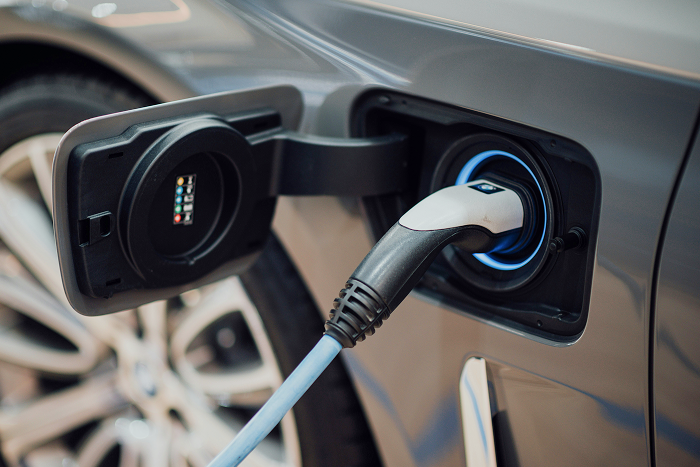
Phenolic composite backing plates are a disruptive idea that has yet to find acceptance, which is surprising considering they around 75% lighter, inert and corrosion free, thermally insulating and have superior damping properties - just the characteristics required for electric vehicle braking duty cycles…
A Regenerative Revolution
Electric cars are heavy, usually much heavier than their ICE counterparts. This is due mainly to the additional weight of the battery packs, adding up to 500kg -800kg to the vehicle’s overall weight, with some models carting over a tonne of batteries, directly affecting the braking system design and sizing. The rise in weight is not insubstantial, with models such as the Mercedes-Benz EQV Luxury passenger van approaching 3 tonnes, whilst the Audi e-tron 55 SUV and several other luxury models weigh in at over 2,600 kg. Even the lighter mid-range C-segment electric models average at almost 1,940 kg, - over 600kg heavier than ICE versions.
Electric vehicle regenerative braking systems are transforming the duty cycle required of foundation brakes, where regenerative systems account for the majority of vehicle braking during day-to-day driving. However, conventional “foundation” braking systems cannot yet be dispensed with, and now provide the back-up braking system on E-vehicles. Foundation brakes are an absolute necessity in emergencies, but also a more basic reason is that regen. systems are not effective if the battery charge is greater than 80%, and require foundation braking to provide a means of bringing the vehicle to controlled and complete stop, plus providing parking braking. The increased weight of electric vehicles results in the prospect that larger, and hence heavier, foundation brakes need to be carried for the vehicle’s lifetime despite being significantly under-utilised On top of this, the extra weight from a heavy braking system has a disproportionately large impact on the vehicle’s fuel efficiency. This is because braking systems are part of the vehicle’s unsprung weight, where heavier unsprung mass is never welcomed by vehicle designers, requiring additional mass elsewhere, e.g. in the suspension system to control vehicle handling.
On the other hand, whilst larger and consequently heavier braking systems will be required, duty cycles promise to be drastically reduced, leading to much lower pad/lining wear, directly affecting after-market pad sales. Whilst claims of brake pads never needing to be changed (Musk, 2018) might be overblown, it is commonly believed that corrosion will become the primary reason people will replace brake pads - as is often the case for current cast-iron brake discs.
The Impact of Legislation
Another impinging factor is the Euro 7 emissions standards, proposals due to be presented to the European parliament at the end of 2021 likely be adopted in the fourth quarter of 2021 and put into force around 2025. This initiative, which is part of the European Green Deal, will develop stricter emissions standards (Euro 7) for all petrol and diesel cars, vans, lorries and buses. NEE (Non-Exhaust Emissions) from road traffic refers to particles released into the air from brake wear, tyre wear, road surface wear. These emissions arise regardless of the type of vehicle and its mode of power, and contribute to the total ambient particulate matter burden associated with human ill-heath. Whilst legislation has been effective at driving down emissions of particles from the exhausts of internal-combustion-engine vehicles, the NEE proportion of road traffic emissions has increased. This is certainly set to continue with the upward expansion of the EV market.
Brake wear is estimated to contribute up to 55% by mass to non-exhaust traffic-related emissions1. However, lighter duty cycles for foundation brakes would automatically lead to lower brake pad wear, and other emission sources such as corrosion products will form a higher proportion of emissions, where Iron in the form of rust is the most abundant metal (up to 60%) found in brake wear debris2. Particle-induced X-ray emission analysis of wear debris revealed that Fe dominated metallic content in both fine and coarse fractions, while TEM analysis showed the presence of maghemite (γ-Fe2O3), magnetite (FeO-Fe3O4), amorphous carbon in the nanoparticle fraction, γ-Fe2O3, FeO-Fe2O3, and hematite (α-Fe2O3) in the fine fraction3. Suffice to say, controlling emissions in the future is likely to involve controlling corrosion in braking systems.
The main sources of iron-rich emissions are from the pad lining, the iron disc and corrosion products from the 4-10mm thick mild-steel backing plates conventionally used as part of all pads. One answer is to galvanising the steel –where NRS brakes have introduced this technology where galvanized pads targeting the EV market are now available for several models including the Audi E-tron SUV. Given the need to reduce vehicle weight, especially unsprung weight, but also to meet Euro 7 standards and drive down further on NEE emissions, manufacturers are starting to consider more radical innovations in the traditionally very conservative area of foundation disc brakes. One of these is the full-composite brake pad – where the steel backing plate is replaced with a polymer composite alternative, offering the prospect of a corrosion-free solution and 75% reduction in weight compared to steel, and most importantly, composite plates are 65-times more thermally insulative than steel. This has a major impact on brake performance. significant brake fade is due to heat getting into the brake fluid, causing expansion and so-called "long pedal" i.e. spongy inconsistent braking. Fluid heating can also lead to catastrophic brake failure due to boiling, where recent race- pace track testing shows that composite pads eliminated these problems even in braking scenarios where discs are reaching 700oC+. Composites also offer unique noise damping characteristics helping to remove the need for noise abatement accessories and extra shims, and could be tuneable, so providing another weapon to eliminate NVH issues.
Investigating a Composite Alternative
The idea has been around for some time, with Phenolic resin maker Sumitomo Bakelite Corporation announcing a polymeric backing plate technology in an SAE technical paper in 20124. Sumitomo have also teamed up with NRS brakes to produce a lighter hybrid metal/phenolic resin backing plate5. The main challenges for this technology surround composite stiffness and how well backing plate stiffness is retained at elevated temperatures of 350oC+. The plate must remain rigid and intimately bonded to the friction lining even after multiple high pressure and high temperature duty cycles. The plates must also experience no adverse effects from other environmental conditions (e.g. moisture, freezing etc.). Tribol’s technology was originally developed at the University of Exeter in collaboration with a consortium of materials suppliers, brake manufacturers and OEM’s seeking a workable solution robust enough to be used within the electric vehicle sector. The innovation was one aspect of a 4yr study into lightweight foundation braking systems for electric vehicles, funded by the UK government.
Tribol's Solution
The Tribol solution uses that a similar family of materials as developed by NASA for space vehicle re-entry shields used to protect the craft from the extreme frictional heat generated when passing through our atmosphere. Tribol has adapted this technology to provide a cost-effective phenolic based composite, that is able to retain its stiffness to over 350oC.
Tribol pads have undergone exhaustive testing since 2016. Beginning with all industry-standard (SAE) with additional test regimes as specified by individual car makers, and onwards, to specialised track and race-standard testing both on dyno and on track. These tests are designed to push braking systems to their limits with some extreme tests with heavier more powerful vehicles seeing discs reaching 900oC. Tribol’s pads remained intact and functional throughout, paving the way to a new future for brake pad design.
[1] Riediker et al., 2008; Bukowiecki et al., 2009a; Gasser et al., 2009; Harrison et al., 2012; Lawrence et al., 2013.
[2] Gadd and Kennedy, 2000; Chan and Stachowiak, 2004; Kukutschová et al., 2011,
[3] Kukutschová J, Moravec P, Tomášek V, Matějka V, Smolík J, Schwarz J, Seidlerová J, Šafářová K, Filip P (2011) On airborne nano/micro-sized wear particles released from low-metallic automotive brakes. Environ Pollut 159:998–1006.
[4] Inokuchi, H., "Integral Molded Brake Pad with Long Fiber Thermosetting Molding Compound for Automotive Brake System," SAE Technical Paper 2012-01-1834, 2012, https://doi.org/10.4271/2012-01-1834.
[5] https://thebrakereport.com/sbcl-and-nucap-develop-composite-material-to-handle-extreme-vehicle-heat/
About the Author
Dr Luke Savage
CTO & Co-founder, Tribol Braking
Dr Luke Savage is the CTO and Co-founder of Tribol Braking, bringing deep technical expertise in braking systems, friction materials, and high-temperature performance.
Luke’s career began with a PhD focused on “High Temperature Properties of Automotive Friction Materials”, and has since included managing over 20 successful Innovate UK-funded projects spanning materials science, braking technology, and automotive engineering.
The research underpinning Tribol Braking originated from one of these programmes, providing the foundation for the company’s composite brake technology. Luke continues to lead Tribol’s technical direction, ensuring every product is grounded in validated science, rigorous testing, and real-world performance.


Leave a comment
All comments are moderated before being published.
This site is protected by hCaptcha and the hCaptcha Privacy Policy and Terms of Service apply.